
10 things on AI and development
Writing on the 'big' AI and development questions that I've been reading, and some thoughts.

In a recent blog, I outlined why the development community is failing to step up on AI, particularly on the most important questions.
Thankfully, though, there are an increasing number of researchers and practitioners bucking the trend. So I thought I’d compile the ten most interesting pieces I’ve recently read on AI and development. If you find this useful, I’ll do it again when I reach ten more things worth reading.
Thing 1: What will be scarce

I contemplated whether it was even necessary to link to this, as I’m sure you’ve all read it. A couple of thoughts. First, this is exactly why I called for more researchers like Alex Imas writing about AI and development. Second, in the comments Alex promised a separate piece outlining what this thesis would look like for developing countries, which I am excited to read.
As I commented, my initial reaction was that the future Alex outlines is a hard one for developing countries to navigate, and I’m not sure how the preferences for a human touch will extend globally - i.e. if a society has experience with human therapists, their preference for them over AI could be different to a society with no prior access to human therapists. If our preference for humans in different roles is not a given, but is learned through experience, then it’s unclear to me that it will hold in places where AI extends access to doctors/therapists for the first time.
This is clearly a crucial research agenda more generally, i.e. doing the type of work Alex did on preferences for AI-generated art, across countries and sectors. Would love to hear about more research of this type.
Thing 2: The intelligence is plenty
Dan Björkegren: “The economies that LMICs trade with, compete with, and depend on are being reorganized around abundant intelligence. The question is not whether LMICs will be affected—they will be—but how they will engage. The analysis above suggests that AI that augments knowledge workers is likely to disproportionately benefit rich countries. It is less clear what alternative paths exist, but there are actions that could offer opportunities, particularly for middle-income countries and more advanced regions within low-income countries.”
YES.
Thing 3: On India’s AI Policy

Rohit Lamba and Raghuram Rajan: “India does not need to beat OpenAI at frontier reasoning today, but it needs to learn to compete: Alternative model architectures and approaches at meaningful scale, sovereign compute, and foreign deals structured around expanding Indian capability rather than only power and land. The Indian state knows how to create a gigawatt of power for a foreign data centre. It needs to learn how to create a research department, a laboratory, a generation of scientists”.
At the moment, it’s very much the US, then China, at the frontier — BIG GAP HERE — and the rest of us lagging behind. I’m not sure how feasible it will be for any country to join the US and China, and it would certainly be foolish for most to try. But this is an interesting argument for India to make that bet.
Things 4 and 5: AI in an open economy
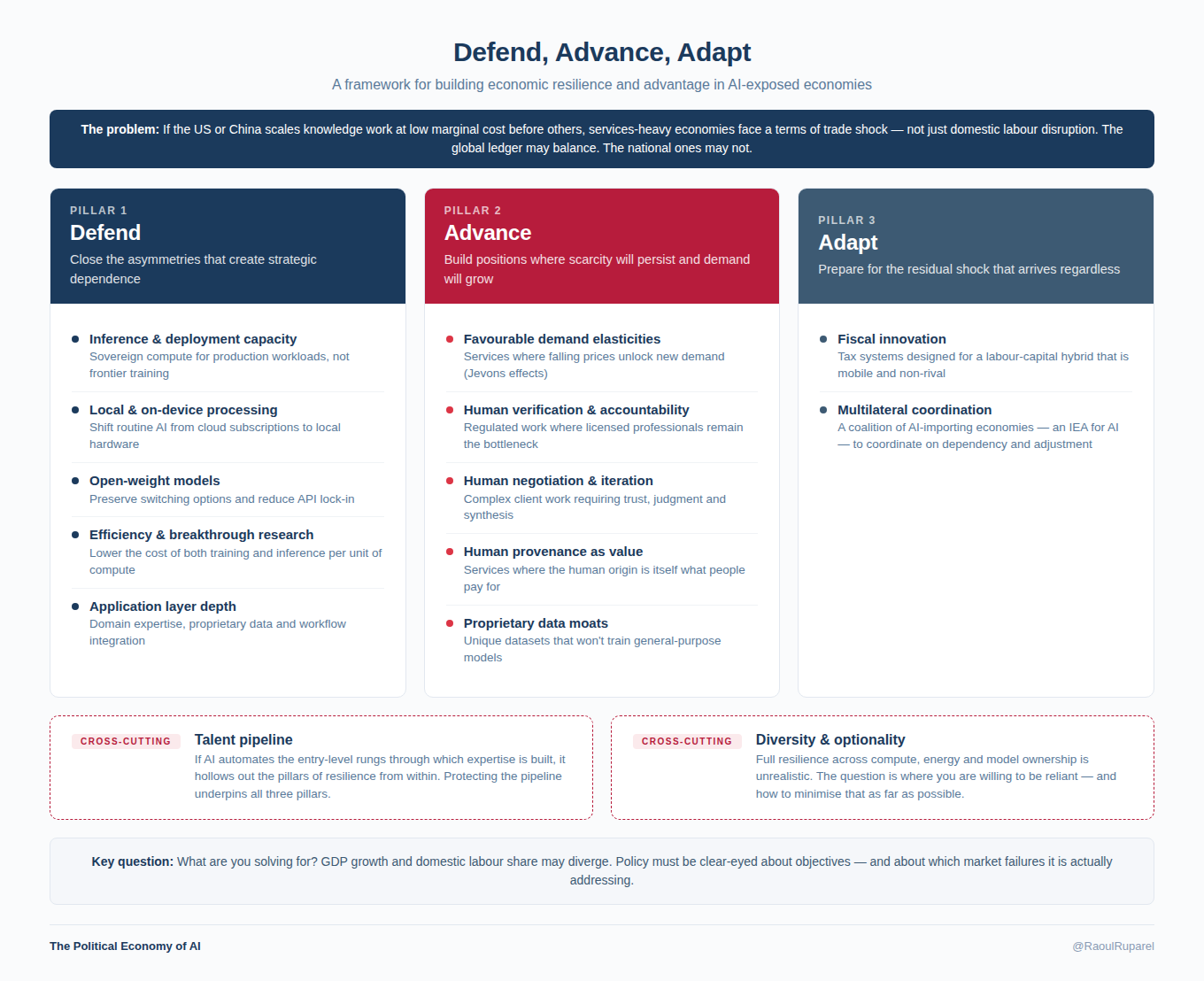
On ‘the rest of us’, Raoul Ruparel has a great two part series on his Substack.
“Fundamentally, given ownership concentration, we could see a situation where the owners of the capital and IP are located in the US or China but the displaced workers are in countries such as the UK, India, and other major importers of AI or exporters of services.”
Raoul shares my worries.
Raoul, in Part 2, thinks through some solutions, and applies them to the UK, but I think there are many generalisable lessons/thought experiments.
Thing 6: Leapfrogging?
Rose Mutiso joined The AI Shift newsletter by the FT (John Burn-Murdoch and Sarah O’Connor) to outline why she feels countries can’t leapfrog into AI, and a whole lot more.
For those who don’t have a subscription, Rose discussed similar themes on Deena Mousa and I’s podcast.

Thing 7 & 8: AI, other general purpose technologies, and South Africa

“The interesting question has never been ‘will it replace us?’ It has always been ‘where does labour go, and who gets there first?’ AI fits that pattern, with one new wrinkle. It automates cognition itself, and its speed of diffusion is unusual even by the standards of earlier GPTs. That combination is what makes the present moment genuinely different…” Johan Fourie
Also from Johan, on AI in South Africa.
Thing 9: Tech for good in the AI age
Han Sheng Chia: Cutting Through the Noise: Reimagining Tech for Good
“The point is not to overgeneralize harm—if well developed and scaled, AI can deliver substantial positive impact. It’s to understand under what conditions harmful uses scale so dramatically that they create “overmatch”: a situation where positive applications are dwarfed by the reach of harmful ones.”
Thing 10: Many more things
I had previously been compiling everything relevant to AI and development economics (not just the ‘big’ questions) in this VoxDev blog, and I will continue to update it periodically.
AI and development economics: Early evidence and how to keep up